Trimoryn Official Website › Journal › Forty-Five Milligrams Of Glucomannan, And The Four Grams The Trial Used
Forty-Five Milligrams Of Glucomannan, And The Four Grams The Trial Used
The konjac row is the best-disclosed entry on this panel and one of the smallest against its own literature. Both facts come from the same printed standardisation.
- Standardised to 90% glucomannan, so 50 mg of konjac extract is 45 mg of fibre.
- The cleanest weight trial used 3.99 g a day for eight weeks and found no weight loss and no change in hunger.
- Pooled trials do show cholesterol and modest weight effects, and viscosity is the property that matters.
- Take it with a full glass of water and fifteen to thirty minutes before food.
The row, and the arithmetic it makes possible
Konjac Extract Fiber (Std. 90% Glucomannan), 50 mg, dagger. That standardisation is the most useful piece of print on the whole Trimoryn panel, because it turns a vague entry into a checkable one: ninety per cent of fifty milligrams is forty-five milligrams of glucomannan a day.
Most panels do not give you that. An entry reading simply "konjac extract 50 mg" would leave a reader unable to say whether the fibre content was five milligrams or forty-five, and there would be no way to find out. This label closes that gap, and it is worth crediting before the rest of this piece takes the number apart.
Forty-five milligrams is the figure. Everything below is about what that figure is next to.
What glucomannan does, physically
Glucomannan is a soluble fibre from the root of the konjac plant, and it is interesting for one reason: it is among the most viscous substances in the food supply. It absorbs many times its own weight in water and thickens what it is in.
Everything claimed for it follows from that single property. A thickened stomach content empties more slowly, so a meal feels present for longer. A thickened intestinal content slows the absorption of sugars, which is the mechanism behind its blood-glucose findings. And a viscous gel binds some bile acids, which is the mechanism behind its cholesterol findings.
It is not metabolised, it is not absorbed, and it does nothing at all systemically. In that respect it is the least pharmacological ingredient on this panel and the easiest one to reason about: it works by taking up space, or it does not work.

The trial that used four grams a day
Keithley and colleagues ran the cleanest test of glucomannan for weight that exists. Fifty-three adults aged 18 to 65 with a body mass index between 25 and 35, randomised to glucomannan or an identical placebo capsule, eating their own self-selected diets. The dose was 1.33 grams with eight ounces of water one hour before breakfast, lunch and dinner, so 3.99 grams a day, for eight weeks.
The result was nothing. No significant difference in weight loss between the groups, and none in body composition, hunger, fullness, lipids, glucose or any of the safety outcomes. Both groups lost about four tenths of a kilogram. The authors' own conclusion is that glucomannan was well tolerated and did not promote weight loss.
That is the honest anchor for this row, and it cuts in a direction most pages in this category would rather not print. Forty-five milligrams is about one ninetieth of 3.99 grams. The relevant comparison is not a smaller effect at a smaller dose; it is no effect at the larger one.
| Amount of glucomannan | Over | What was found | |
|---|---|---|---|
| This panel | 45 mg a day | one capsule, before a meal | not tested at this amount |
| Keithley 2013 | 3,990 mg a day | 8 weeks, 53 adults | no weight loss, no change in hunger or fullness |
| Sood 2008, pooled | not stated in the record | 14 trials, 531 people | body weight down 0.79 kg, total cholesterol down 19.3 mg/dL |
What the trials that did find something used
The picture is not uniformly negative, which is why one trial is not the whole story. A meta-analysis of fourteen trials in 531 people found glucomannan lowered total cholesterol by 19.3 mg/dL, LDL cholesterol by 16.0 mg/dL, triglycerides, fasting blood glucose and body weight by 0.79 kg. Those are real pooled effects and the lipid findings are the more convincing half of them.
A cross-over trial in sixteen healthy adults tested the appetite claim directly, by replacing a high-carbohydrate preload with volume-matched konjac gel noodles. Cumulative energy intake fell by up to 47% and people did not eat more at the following meal to compensate, so the deficit held. Hunger ratings rose on the largest substitution, which is the caveat the paper itself prints.
A comprehensive review of 136 human fibre intervention studies is the widest view and the most sceptical. Most extracted and isolated fibres did not move appetite ratings or energy intake at all. The ones that did were the viscous ones, which is where glucomannan sits, and fermentability made no difference. That review is the reason viscosity keeps appearing in this article: it is the property that separates the fibres that do something from the ones that do not.
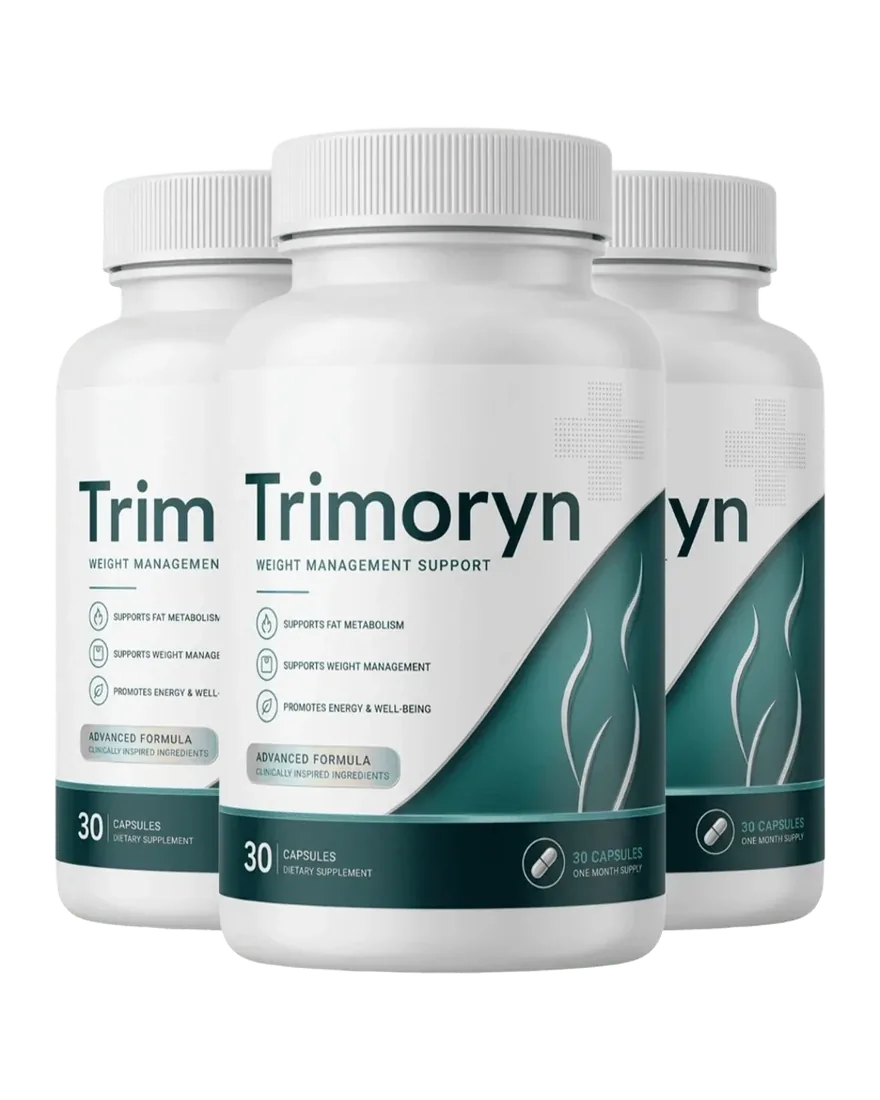
The whole Trimoryn panel, with every amount printed
Eleven entries and the extract ratios and standardisations that make comparisons like this one possible.
$49 to $79 a bottle · 60 days from purchase
Order TrimorynWhat a fibre cannot do, whatever the amount
Two limits are worth stating before the practical part, because both get implied away in this category.
A viscous fibre does not remove calories that have already been eaten. It slows absorption and it makes a given volume of food feel present for longer, and in the trials that found anything the effect ran through eating less at the next meal rather than through anything happening to the last one. That is a behavioural route with a physical prompt, which is a real thing and a modest one.
It also does nothing at all on a day it is not taken. Unlike a mineral, which reaches a steady level over weeks, a fibre acts in the hours after it is swallowed and then leaves. So the fibre contribution over sixty days of this capsule is really a count of how many of those sixty days it was taken before food, which is a stronger argument for the routine set out on the how-to-take page than for any particular amount.
The third limit is one the label concedes by putting the fibre tenth on a panel of eleven: this is not a fibre supplement. A product sold as one carries grams and says so on the front of the bottle.
Why the label still tells you to take it with water
The suggested use on the bottle reads: as a dietary supplement, take one capsule daily, preferably 15 to 30 minutes before a meal. The water is not printed but it is the sensible companion, and the reason is this row.
A viscous fibre needs water and time to do anything at all. A capsule swallowed with a mouthful of coffee as the food arrives has had neither. Taken twenty minutes ahead with a full glass, the fibre has begun to hydrate before the meal gets there, which is the state every one of the trials above was testing.
There is a second reason, which is safety rather than efficacy. Viscous fibres taken dry are the mechanism behind the occasional reports of throat and oesophageal obstruction attached to glucomannan tablets. Forty-five milligrams in a small capsule is a small quantity and the mitigation is free: water, and do not lie down immediately.
- One capsule, fifteen to thirty minutes before a meal.
- A full glass of water, not a mouthful.
- The meal you never skip, so the habit survives week three.
- Separate it from any medicine by a couple of hours, because a viscous fibre slows absorption of whatever is in the stomach with it.
What the fibre is actually doing in this capsule
Probably very little on its own, and that is a defensible thing for a label to include anyway. Forty-five milligrams will not thicken a stomach's worth of food, and the one clean weight trial at ninety times the amount found nothing. Anybody buying this capsule primarily for appetite control is buying the wrong thing, and the dosage comparison prints why in one row.
What the entry does do is sit alongside three botanicals at 100 mg each and a riboflavin dose at fourteen times its reference intake, in a capsule taken before a meal. The routine is the part with a behavioural effect and the label is honest about the routine: a capsule fifteen minutes before food is also fifteen minutes of thinking about food before it arrives.
The one-line version
The standardisation on this row is exemplary and the amount behind it is a gesture. Both of those are worth knowing, and a label that prints the first is easier to respect than one that hides it.
For what a fibre supplement bought for its own sake would look like, the category guide sets out the four kinds of thing sold in this aisle and what to check on each.
Sources cited in this article
- Keithley JK, Swanson B, Mikolaitis SL, DeMeo M, Zeller JM, Fogg L, Adamji J. Safety and efficacy of glucomannan for weight loss in overweight and moderately obese adults. J Obes. 2013;2013:610908. https://pubmed.ncbi.nlm.nih.gov/24490058/
- Sood N, Baker WL, Coleman CI. Effect of glucomannan on plasma lipid and glucose concentrations, body weight, and blood pressure: systematic review and meta-analysis. Am J Clin Nutr. 2008;88(4):1167-1175. https://pubmed.ncbi.nlm.nih.gov/18842808/
- Au-Yeung F, Jovanovski E, Jenkins AL, Zurbau A, Ho HVT, Vuksan V. The effects of gelled konjac glucomannan fibre on appetite and energy intake in healthy individuals: a randomised cross-over trial. Br J Nutr. 2018;119(1):109-116. https://pubmed.ncbi.nlm.nih.gov/29202887/
- Mah E, Liska DJ, Goltz S, Chu Y. The effect of extracted and isolated fibers on appetite and energy intake: A comprehensive review of human intervention studies. Appetite. 2023;180:106340. https://pubmed.ncbi.nlm.nih.gov/36216214/