Trimoryn Official Website › Journal › Riboflavin At 1,470 Per Cent, And Why It Is The Safest Number Here
Riboflavin At 1,470 Per Cent, And Why It Is The Safest Number Here
One entry on this panel carries a percent Daily Value and it is printed at fourteen times it. What that figure means and why no upper limit exists for it.
- Riboflavin is the only entry on this panel with an established Daily Value.
- 25 mg is about twenty times the adult reference intake of 1.1 to 1.3 mg a day.
- No Tolerable Upper Intake Level has been set, because high intakes have not produced reported harm.
- Bright yellow urine for a few hours is the ordinary and harmless consequence.
The only percentage on the panel
Riboflavin (Vitamin B2), 25 mg, 1,470%. It is the first row on the Trimoryn panel and it is the only one of the eleven carrying a percent Daily Value. The other ten are marked with a dagger, which means no Daily Value has ever been established for them.
Fourteen hundred and seventy per cent is the largest number printed anywhere on this bottle and it is the one most likely to make a reader stop. This piece is about why it is there, what it means and why it is not the alarming figure it looks.
It is also the one entry on this panel where the comparison with the published work runs the other way. Everywhere else on this label the amount is smaller than the research used. Here it is roughly twenty times larger than the reference intake.
Why a large percent is not a large risk
A percent Daily Value compares the amount in a serving with a reference intake set for the general adult population. The NIH fact sheet on riboflavin gives that reference as 1.1 mg a day for adult women and 1.3 mg for adult men. Against the 1.7 mg figure used for labelling, 25 mg comes out at about 1,470%.
The next question a reader asks is what the upper limit is, and the answer is that there is not one. The Food and Nutrition Board did not set a Tolerable Upper Intake Level for riboflavin, and the fact sheet gives the reason: adverse effects from high riboflavin intakes from foods or supplements have not been reported, including at 400 milligrams a day for at least three months. The fact sheet also records that riboflavin is not known to have any clinically relevant interactions with medications.
Riboflavin is water-soluble and poorly stored. Absorption in the gut is limited by an active transport mechanism that saturates, and what is not absorbed passes through. What is absorbed beyond immediate need is excreted in urine. Those two facts together are why a nutrient can sit at twenty times its reference intake without an upper limit attached to it.
| Amount | Where it comes from | Note | |
|---|---|---|---|
| Adult reference intake, women | 1.1 mg a day | NIH Office of Dietary Supplements | the figure the percentage is calculated against |
| Adult reference intake, men | 1.3 mg a day | NIH Office of Dietary Supplements | a small difference between the sexes |
| This panel | 25 mg a day | the printed label | about twenty times the reference intake |
| Studied without adverse effect | 400 mg a day | cited in the NIH fact sheet | for at least three months, no adverse effects reported |
| Tolerable Upper Intake Level | none set | Food and Nutrition Board | because high intakes have not produced reported harm |
What riboflavin actually does
Riboflavin is the precursor of two coenzymes, flavin mononucleotide and flavin adenine dinucleotide. Those two carry electrons in the reactions that release energy from fats, carbohydrates and protein, and they are involved in the metabolism of several other vitamins besides.
That is the mechanism behind the bottle's third support line, which reads promotes energy and well-being. It is the plainest and best-established mechanism on this panel, and it is worth being precise about what it does and does not imply. A nutrient with a role in energy-yielding metabolism is not a stimulant. Twenty-five milligrams of riboflavin will not make anybody feel anything in the way a cup of coffee does, and a page that implied otherwise would be overselling the one entry here that does not need it.
A review of recent human riboflavin research covers the wider picture: absorption and its regulation, what deficiency looks like, the effect on iron absorption and tryptophan metabolism, and the conditions in which riboflavin supplementation has been studied. MedlinePlus is the short version for a reader who wants the essentials and not the literature.
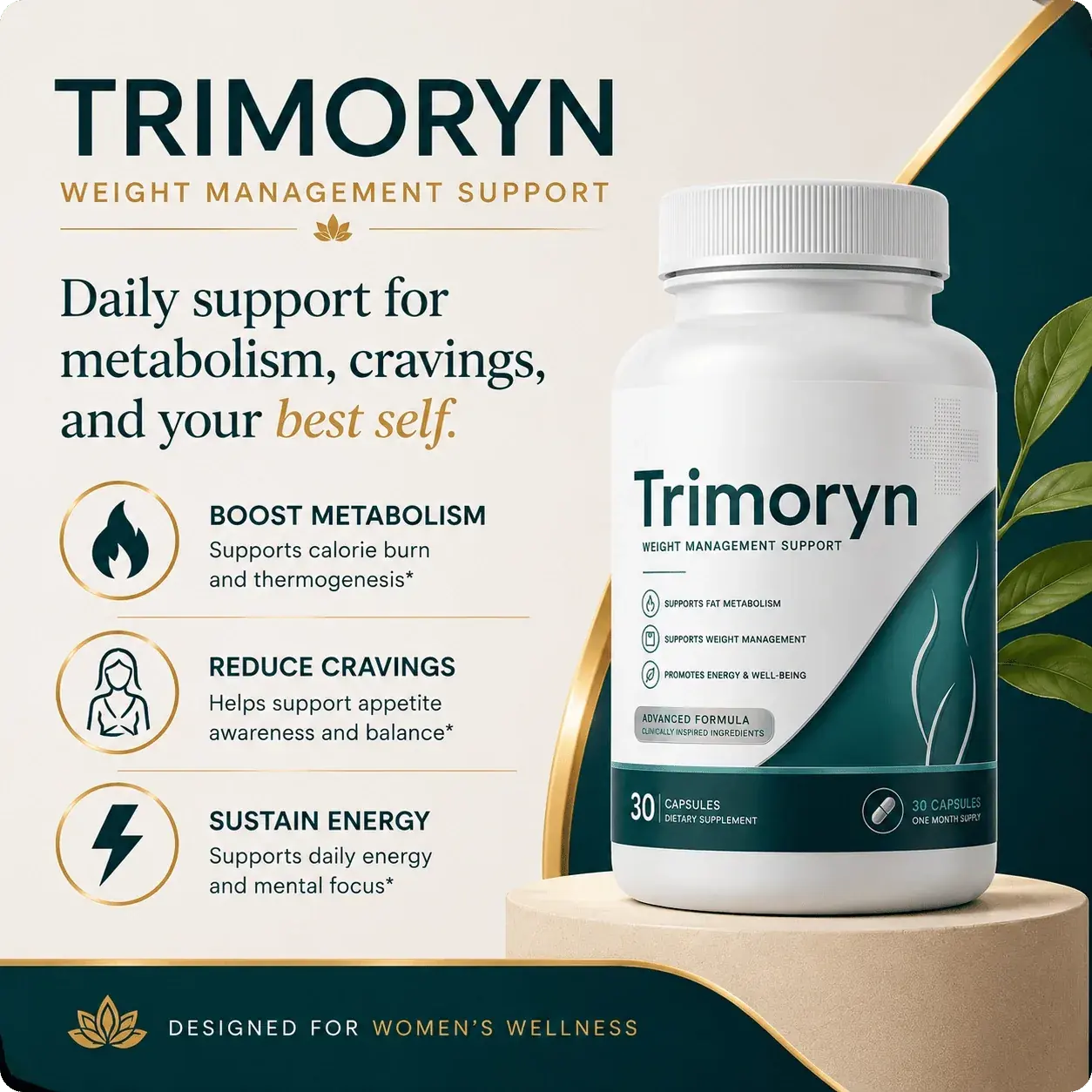
The rest of the Trimoryn panel, entry by entry
Eleven rows, ten of them marked with a dagger, and the one that carries a percentage is the row this article is about.
$49 to $79 a bottle · 60 days from purchase
Order TrimorynHow riboflavin is absorbed, and why that caps it
The reason 25 mg of a B vitamin behaves so differently from 25 mg of something fat-soluble is absorption. Riboflavin crosses the intestinal wall through a saturable transport system, so the proportion absorbed falls as the dose rises. Past a certain point, extra riboflavin in a capsule passes straight through.
What is absorbed is converted into its two coenzyme forms and held in tissue in modest quantities. There is no large riboflavin store in the body of the kind that exists for vitamin A or vitamin B12, and the surplus is cleared in urine within hours. Two mechanisms, both of them limiting, and between them they are why no Tolerable Upper Intake Level exists for this nutrient.
It also explains something a reader will have noticed on other labels. B-vitamin doses in multivitamins and energy formulas are routinely printed at several hundred per cent of their Daily Values while the minerals on the same panel sit near a hundred. That is not a difference of ambition, it is a difference of chemistry, and a mineral at fourteen times its reference intake would be a very different conversation.
The yellow urine question
This is the most common thing anybody notices after starting a B-complex or a multivitamin, and it comes almost entirely from riboflavin. The vitamin is a strong yellow pigment, it is water-soluble, and what the body does not need leaves in urine within a few hours.
It is harmless. It is not a sign of damage, of waste in any meaningful sense, or of the dose being too high. It is the visible consequence of taking more of a water-soluble vitamin than is needed at that moment, which is exactly what a 25 mg dose is.
- It appears within a few hours of the capsule and fades the same day.
- It is more noticeable first thing in the morning, when urine is more concentrated.
- It is not a reason to stop, and it is not a reason to take less than the label says.
- It is worth knowing about in advance, because unexplained it is alarming.
Where large riboflavin doses have actually been studied
The 400 mg a day figure quoted above is not an arbitrary safety ceiling. It comes from a body of research using riboflavin at that amount for a purpose that has nothing to do with this bottle, and it is the reason the tolerability question is as settled as it is. The review of recent human riboflavin research covers that literature alongside the deficiency work.
Two things follow for a reader of this panel. The first is reassurance: a nutrient given at sixteen times the amount in this capsule, for months, without reported adverse effects, is a nutrient whose 25 mg entry does not need weighing carefully. The NIH fact sheet states both halves of that plainly, including the absence of known medication interactions.
The second is a caution about reading across. Research at 400 mg for one purpose is not evidence for 25 mg for a different purpose, and nothing on this website suggests it is. The riboflavin row supports the energy and well-being line on the bottle because riboflavin is a coenzyme precursor in energy-yielding metabolism, which is a textbook fact rather than a trial finding, and that is the whole of the claim being made for it here.
It is worth contrasting that with the rows further down the panel, where the research is trial-based and the amounts are a fraction of what those trials used. The dosage comparison sets the two kinds of claim side by side rather than letting a strong row stand in for a thin one.
What 25 mg does not do
It does not make this a weight loss ingredient. Riboflavin has a role in energy metabolism in the sense that it is a required cofactor, and a required cofactor supplied in excess does not accelerate anything. The rate of a metabolic pathway is set by other things entirely in anybody who is not deficient.
It does not correct a deficiency most readers have. Riboflavin deficiency is uncommon in populations eating dairy, eggs, meat or fortified cereals, which is most of the countries this product is sold into.
And it does not compensate for the thinner rows further down the panel. This entry is generous, four rows further on the turmeric is at 15 mg and the resveratrol at 12, and the dosage comparison prints all six comparisons in one table rather than letting the generous one stand for the rest.
Why it is probably here
Two plausible reasons and both are ordinary. Riboflavin is cheap, it is stable, and it is the one ingredient that lets a panel print a percent Daily Value at all, which makes the label look more like a vitamin label and less like a botanical one. It is also the honest carrier for the energy support line, which would otherwise have nothing behind it.
The one-line version
The largest number on this bottle is the safest one on it. A nutrient with no upper limit, no known medication interactions and a visible harmless side effect, at about twenty times a reference intake that most readers already meet from food.
The rest of the label, including the four rows where the amount runs the other way, is on the ingredients page.
Sources cited in this article
- NIH Office of Dietary Supplements. Riboflavin: Fact Sheet for Health Professionals. https://ods.od.nih.gov/factsheets/Riboflavin-HealthProfessional/
- Thakur K, Tomar SK, Singh AK, Mandal S, Arora S. Riboflavin and health: A review of recent human research. Crit Rev Food Sci Nutr. 2017;57(17):3650-3660. https://pubmed.ncbi.nlm.nih.gov/27029320/
- MedlinePlus Medical Encyclopedia. Riboflavin. U.S. National Library of Medicine. https://medlineplus.gov/ency/article/002411.htm