Trimoryn Official Website › Journal › What Do Alpha Lipoic Acid, Turmeric and Resveratrol Add to Trimoryn?
What Do Alpha Lipoic Acid, Turmeric and Resveratrol Add to Trimoryn?
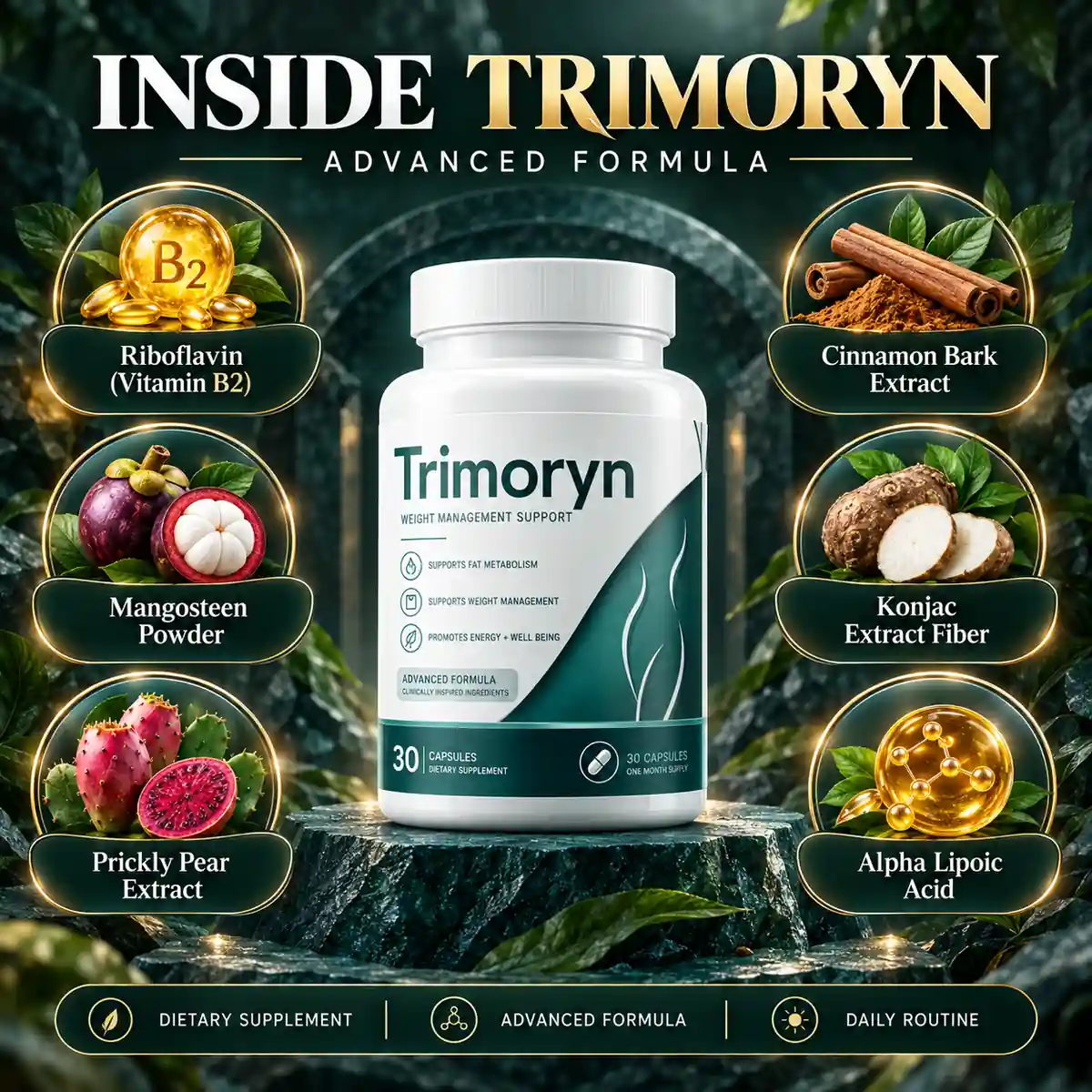
Each Trimoryn capsule holds 25 mg of alpha lipoic acid, 15 mg of turmeric extract and 12 mg of resveratrol extract. Each has a published literature, but each is small here, and turmeric and resveratrol are poorly absorbed. No trial of the finished capsule exists, so none of the three can be shown to do anything in it.
What are alpha lipoic acid, turmeric and resveratrol doing in one capsule?
They are three of the eleven entries on the Trimoryn panel. They share one thing: a lot of research, much of it about weight or body measures, and a long distance between that research and a single small capsule. This page takes them one by one.
The seller's listing graphics name only six ingredients, and alpha lipoic acid is the only one of these three in the circles. Turmeric and resveratrol appear on the order page and on the printed panel. All amounts below come from the panel, and every study figure comes from the sources this site cites.
- Alpha lipoic acid: 25 mg per capsule.
- Turmeric extract, Std. 95% Curcumin: 15 mg, which is 14.25 mg of curcumin.
- Resveratrol extract, Std. 20% from Polygonum cuspidatum: 12 mg, which is 2.4 mg of resveratrol.
- All three carry a dagger on the panel: Daily Value not established.
- No piperine is on the panel, which matters for turmeric.
- No trial of the finished capsule is published.
| Entry | In one capsule | Amount in the cited work | Main caution |
|---|---|---|---|
| Alpha lipoic acid | 25 mg | Pooled across ten trials; no dose link found | Pooled result is modest, and the trials tested the ingredient alone |
| Turmeric (95% curcumin) | 14.25 mg of curcumin | 2 g of curcumin in a human absorption study | Poor absorption without piperine |
| Resveratrol (20%) | 2.4 mg | A 25 mg oral dose | Almost none circulates unchanged |
What is alpha lipoic acid, and what did the weight studies find?
Alpha lipoic acid is an antioxidant the body also makes for itself. It acts as a helper in how cells make energy. At 25 mg, it is the entry on the panel with the largest pooled weight study behind it.
That study is a meta-analysis of ten randomised, double-blind, placebo-controlled trials, published by Kucukgoncu and colleagues in 2017. It found an average of 1.27 kg more weight lost than with placebo, and a mean difference in body mass index of 0.43. These are modest figures from pooled trials.
The part worth reading twice is the meta-regression. It found no link between the dose used and the size of the result. That means a larger number in this row would not automatically have been a better one. So 25 mg is not, by that finding, a weak dose. But it is also not a promise, since the trials were of alpha lipoic acid on its own.
What does turmeric add, and why does absorption matter?
The turmeric entry is a 15 mg extract, standardised to 95% curcumin. That works out to 14.25 mg of curcumin per capsule. A dose-response meta-analysis of 60 randomised trials in 3,691 people, by Dehzad and colleagues in 2023, found that curcumin reduced body weight, body mass index, waist size and leptin, and raised adiponectin. It also noted high differences between studies.
The practical problem is not whether curcumin does anything but whether it gets anywhere. A classic human study found that 2 g of curcumin on its own left blood levels either not detectable or very low. Adding 20 mg of piperine raised the figure by two thousand per cent. There is no piperine on the Trimoryn panel. And 14.25 mg is about one part in 140 of that 2 g.
If you would like to see the full panel and the order terms together, the seller's page shows both.
See today’s price and guarantee
This website is commercial and earns from orders placed through the button. Prices were read on 19 September 2026, so check the checkout.
Is turmeric in a supplement safe?
At this amount the concern is small, but the site gives the safety side fairly. The NCBI LiverTox record collects case reports of liver injury linked to concentrated turmeric and curcumin products. Most involved daily amounts far above 14.25 mg, and several involved formulas made to raise absorption.
What matters for you is the sum. Turmeric is one of the most widely taken single-ingredient supplements. If you already take a separate turmeric capsule, Trimoryn adds to it. Count what you take, and tell your doctor. NCCIH has a short page on turmeric for a plain-language view.
What is resveratrol here, and where does it come from?
The panel reads Resveratrol Extract, Std. 20% from Polygonum cuspidatum. That is Japanese knotweed, not grapes. At 12 mg and 20%, a capsule holds 2.4 mg of resveratrol.
An umbrella meta-analysis of the resveratrol literature found effects on body measures and inflammation markers that are real but modest and inconsistent across the reviews it pooled. The older, simpler fact is about absorption. A human study gave six volunteers a 25 mg oral dose. At least 70% was absorbed, but almost none circulated as resveratrol, because the gut and the liver change it almost at once.
At 2.4 mg, the Trimoryn entry is about a tenth of that studied dose. So the honest summary is that resveratrol is on the panel in a token amount, and a modest literature sits behind it.
Do the three add up to a weight loss effect?
Not on the published facts. Each study was done on one ingredient, usually at a different amount, in people chosen for the question. None tested these three together, and none tested the finished capsule. The site says this plainly and does not make a weight-loss claim.
What can be said is smaller. The panel points at several processes that researchers have looked at. The label's support lines are statements about processes, not about pounds. And the strength of the pointing varies a lot between entries. Alpha lipoic acid has the firmest pooled record of the three. Turmeric has a wide record with an absorption problem. Resveratrol has the thinnest case at the amount given.
How should you judge a small amount of a well-studied ingredient?
- Ask what the study actually used. Same compound, same amount, same people?
- Ask whether the compound reaches the blood. Turmeric and resveratrol both have a known problem here.
- Ask whether the label tells you enough. A standardisation, such as 95% curcumin, lets you do the sum. A bare name does not.
- Ask what the trial measured. Weight, a lab marker, or a feeling?
- Ask whether anyone tested the finished product. Here, nobody has published such a test.
Those five questions work on any supplement label, not just this one.
Frequently asked questions
- How much alpha lipoic acid is in Trimoryn?
- Twenty-five milligrams per capsule. It carries a dagger on the panel, meaning no Daily Value is established.
- How much turmeric is in Trimoryn?
- Fifteen milligrams of turmeric extract standardised to 95% curcumin, which is 14.25 mg of curcumin per capsule.
- How much resveratrol is in Trimoryn?
- Twelve milligrams of resveratrol extract standardised to 20%, which is 2.4 mg of resveratrol, from Polygonum cuspidatum.
- Does Trimoryn contain piperine for turmeric absorption?
- No. There is no piperine on the panel, and curcumin is poorly absorbed without it.
- Do these three ingredients cause weight loss in Trimoryn?
- No result is published for the finished capsule. The studies cited looked at single ingredients, usually at different amounts.
- Is it safe to take Trimoryn with a turmeric supplement?
- Count the total. Concentrated turmeric products have been linked to liver injury in case reports, mostly at much higher amounts. Tell your doctor what you take.
Safety note
This page is general information, not medical advice. Trimoryn is a dietary supplement. It is not FDA approved, no supplement is, and it is not a treatment for any condition. The label says it is not for anyone under 18 or anyone pregnant or nursing. If you take a medicine or have a medical condition, talk to a physician before you start.
Our view
These three entries show how a panel can look strong and read modestly. Alpha lipoic acid has a real pooled study behind it, though not for this capsule. Turmeric and resveratrol have big literatures and known absorption problems, and the amounts here are small.
That is not a reason to dismiss them. It is a reason to hold the claims lightly, and to look at the whole routine, food, sleep and activity, before a small capsule. Ask your doctor about anything on the panel that touches your health.
You can read today's packs and the 60-day wording on the seller's own page whenever you are ready.
See today’s price and guarantee
This website is commercial and earns from orders placed through the button. Prices were read on 19 September 2026, so check the checkout.