Trimoryn Official Website › Journal › What 10:1 Means On A Label, And What It Does Not
What 10:1 Means On A Label, And What It Does Not
Extract ratios, standardisations, plain milligram figures and colony counts are four different claims. This panel carries all four.
- A 10:1 extract at 100 mg corresponds to about a gram of raw plant, and says nothing about which compounds survived.
- A standardisation names a compound and a percentage, which makes exact arithmetic possible.
- Three entries on this panel are standardised and four carry a ratio.
- Mangosteen powder carries neither, so it cannot be compared with anything.
Four notations on one panel
The Trimoryn label prints its eleven entries in four different notations, and a reader who does not know the difference will read three of them wrongly. They are worth separating once, because the same four appear on almost every botanical supplement sold.
| What it looks like | What it means | What you can work out | |
|---|---|---|---|
| A plain milligram figure | Mangosteen Powder 100 mg | whole dried plant material, nothing concentrated | the mass of powder, and nothing about its composition |
| An extract ratio | Prickly Pear Extract Powder 4:1, Cinnamon Bark Extract 10:1 | four or ten parts of raw plant reduced to one part of extract | roughly how much raw plant the entry corresponds to |
| A standardisation | Std. 90% Glucomannan, Std. 95% Curcumin, Std. 20% | a stated percentage of a named marker compound | the exact amount of the compound itself |
| A colony count | 1 billion CFU | living organisms rather than a mass | the count, but not the strain unless it is named |
A ratio is a concentration, not a dose
A 10:1 extract means ten kilograms of raw plant were processed down to one kilogram of extract. So 100 mg of a 10:1 cinnamon bark extract corresponds to roughly a gram of bark. That is a useful thing to be able to say and it is the whole of what a ratio tells you.
What it does not tell you is which compounds survived. Extraction is a selective process: a water extract, an ethanol extract and a supercritical carbon dioxide extract of the same plant at the same ratio will contain different things in different proportions. Two 10:1 extracts of the same bark can be quite different products, and the ratio on the label does not distinguish them.
It also does not tell you what was removed. A ratio of ten to one means nine parts in ten were discarded, and which nine depends entirely on the method. This is why a ratio is the weakest of the three botanical notations even though it looks the most technical.
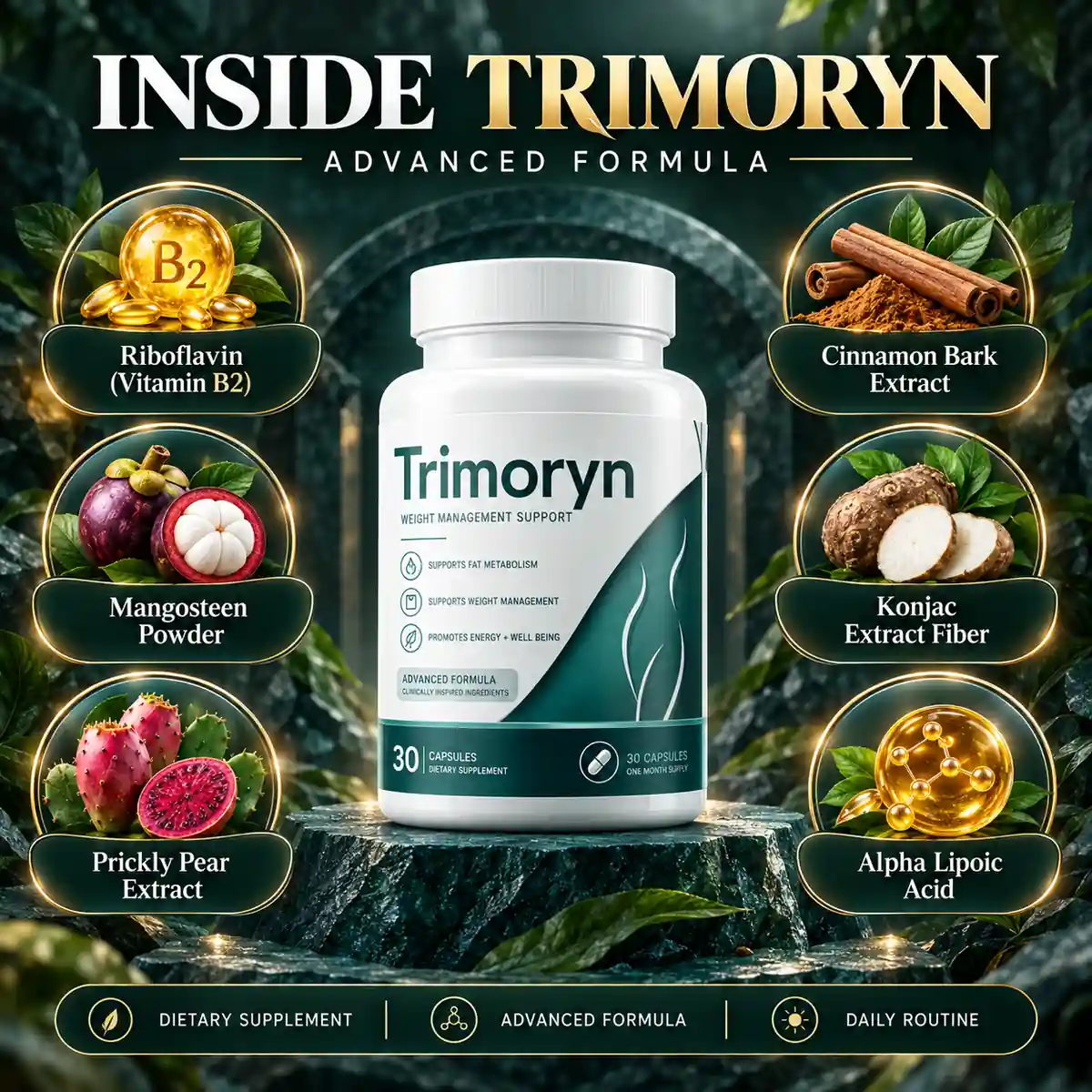
Read it as a rough scale factor and nothing more. On this panel it says that the cinnamon entry corresponds to about a gram of bark and the prickly pear entry to about 400 mg of cactus, which is enough to compare with a trial that used grams of plant, and not enough to compare with one that used a specific fraction.
A standardisation is the stronger claim
Standardised to 90% glucomannan means nine tenths of that entry, by mass, is the named compound. It converts a vague quantity into an exact one: 50 mg of konjac extract at 90% is 45 mg of glucomannan, and that number can be set against any trial that reports a glucomannan dose.
This panel carries three standardisations and they are the three most checkable entries on it.
- Konjac Extract Fiber, Std. 90% Glucomannan, 50 mg. Forty-five milligrams of the fibre itself.
- Turmeric Extract, Std. 95% Curcumin, 15 mg. Fourteen and a quarter milligrams of curcumin.
- Resveratrol Extract, Std. 20% from Polygonum Cuspidatum, 12 mg. Two and four tenths of a milligram of resveratrol, and a named source plant besides.
A standardisation is not a guarantee that the rest of the extract is inert or that the marker compound is the active one. It is a guarantee about a quantity, which is exactly what a reader needs in order to compare a label with a paper.
See every Trimoryn notation in one place
The panel transcribed row for row, with the ratio or the standardisation printed exactly as the label gives it.
$49 to $79 a bottle · 60 days from purchase
Order TrimorynThe entry with neither
Mangosteen Powder, 100 mg. No ratio, no standardisation, no plant part and no marker compound. It is joint-largest entry on the panel by mass and it is the least legible one on it.
That is not a criticism of whole powders in principle. A whole dried fruit powder is a real ingredient and there is nothing dishonest about selling one. The consequence is that the entry cannot be compared with anything: mangosteen research is mostly about xanthones concentrated from the pericarp, and 100 mg of unspecified whole powder stands in an unknown relationship to any of it.
The one randomised trial worth citing here gave 22 women with insulin resistance a mangosteen extract for 26 weeks alongside behavioural therapy and found a large improvement in insulin sensitivity with no attributable side effect. It is a pilot study by its own description, and the record does not state the dose, so no arithmetic is offered on this website for that entry at all. A page that invented one would be making the comparison this article exists to warn against.
Two more notations you will meet on other labels
This panel uses neither of the following, and a reader comparing it with a competitor will meet both inside about two bottles.
The proprietary blend. Several ingredients grouped under an invented name with one total beside it, along the lines of a metabolic support blend at 480 mg. It is legal and it makes the individual amounts unknowable. The only thing a reader can say about such a blend is that no ingredient in it exceeds the total, which on a blend of eight is very little indeed. A panel printing eleven separate amounts is disclosing more than the law obliges it to.
The equivalence claim. An entry reading cinnamon bark extract 100 mg, equivalent to 1,000 mg of cinnamon bark. That is the same arithmetic a 10:1 ratio implies, stated the flattering way round, and the larger number is the one a shopper remembers. Neither form is dishonest. The equivalence form is simply written to be read as a dose when it is a concentration.
Both are worth recognising on sight, because the difference between a good panel and a poor one in this category is very rarely about which ingredients were chosen. It is almost always about how much the notation lets you check.
How to compare a label with a trial
Four steps, and they work on any botanical panel rather than just this one.
- Find the compound the trial dosed. Usually a named fraction: guggulsterones, curcumin, glucomannan, corosolic acid. Not the plant.
- Convert the label entry to the same compound. A standardisation makes this arithmetic; a ratio makes it an estimate; nothing makes it impossible.
- Compare like with like, and expect a large ratio. Multi-ingredient capsules are nearly always below single-ingredient trials, and the useful question is by how much.
- Check whether the trial found anything. A large gap below a null result means something different from a large gap below a positive one.
That fourth step is the one most often skipped. The glucomannan trial cited on this website used 3.99 grams a day and found no weight loss, which means the comparison for a 45 mg entry is not a smaller effect but no effect. The dosage section does all four steps for the six entries on this panel whose cited work states a dose.
The thing no notation tells you: which part of the plant
There is a fifth piece of information a botanical entry can carry and this panel carries it on none of them: the plant part. Bark, root, leaf, fruit, flower and seed are chemically different materials from the same organism, and an extract of one is not an extract of another.
Two of the eleven entries name it by implication. Cinnamon bark extract says bark in its own name. Konjac extract fibre is understood to come from the root, because that is the only part used. Prickly pear extract powder does not say whether it is the fruit or the cladode, which is the flat pad, and those two are used for different purposes in the published work. Mangosteen powder does not say whether it is the pericarp, which is where the xanthones are, or the flesh.
That matters for the same reason a species name matters. When a reader goes looking for the research behind an entry, the search terms are the species and the part, and a label that supplies neither has left the reader to guess at both. A panel that named Garcinia mangostana pericarp rather than mangosteen powder would be a materially more useful document, and it would cost two words.
The twelve-row checklist on the choosing guide scores this panel on exactly these omissions, and it is the reason three of its twelve rows come back as failures on an otherwise well-disclosed label.
What to ask of any label
This panel is above average for its category and the reason is entirely notational. Eleven entries, eleven separate amounts, no proprietary blend, four of five extracts carrying a ratio or a standardisation, and a source plant named for the resveratrol. A great many competitors print a blend name and a total.
Where it falls short is also notational. No species for the cinnamon, the mangosteen or the prickly pear; no strain for either probiotic; and one entry with no concentration information at all. The twelve-row checklist scores all of that explicitly, and three of its twelve rows are about exactly this.
The one-line version
A ratio tells you roughly how much plant. A standardisation tells you exactly how much compound. A plain milligram figure for a whole powder tells you neither, and a colony count without a strain tells you half.
Everything on this panel in one place is on the label page, and what is known about each entry is on the ingredients page.
Sources cited in this article
- Watanabe M, Gangitano E, Francomano D, Addessi E, Toscano R, Costantini D, Tuccinardi D, Mariani S, Basciani S, Spera G, Gnessi L, Lubrano C. Mangosteen Extract Shows a Potent Insulin Sensitizing Effect in Obese Female Patients: A Prospective Randomized Controlled Pilot Study. Nutrients. 2018;10(5). https://pubmed.ncbi.nlm.nih.gov/29747432/
- Keithley JK, Swanson B, Mikolaitis SL, DeMeo M, Zeller JM, Fogg L, Adamji J. Safety and efficacy of glucomannan for weight loss in overweight and moderately obese adults. J Obes. 2013;2013:610908. https://pubmed.ncbi.nlm.nih.gov/24490058/
- Shoba G, Joy D, Joseph T, Majeed M, Rajendran R, Srinivas PS. Influence of piperine on the pharmacokinetics of curcumin in animals and human volunteers. Planta Med. 1998;64(4):353-356. https://pubmed.ncbi.nlm.nih.gov/9619120/
- Walle T, Hsieh F, DeLegge MH, Oatis JE, Walle UK. High absorption but very low bioavailability of oral resveratrol in humans. Drug Metab Dispos. 2004;32(12):1377-1382. https://pubmed.ncbi.nlm.nih.gov/15333514/